It was this 1950's TV series Staring Richard Green and...
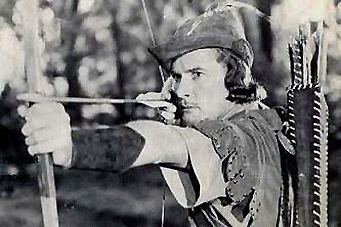
The Adventures of Robin Hood starring the swashbuckling Errol Flynn...
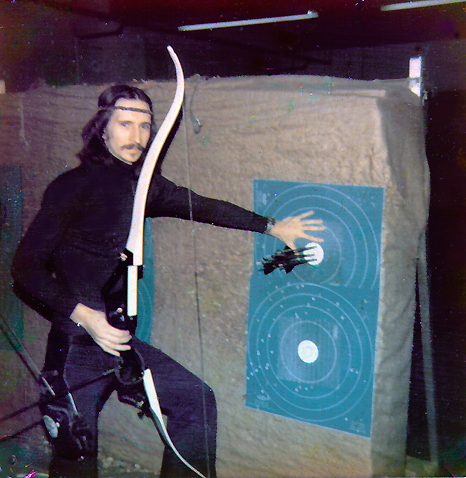
That got me started shooting arrows in later life. This is a league picture taken after the last end for high Bare Bow score that night. This picture was posted on the wall, with my score, till the end of the league season.
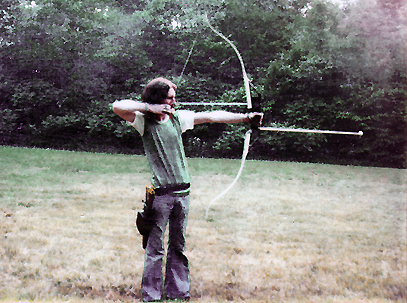
I had started out with a Bear Panda shooting instinctive,
then later went to shooting a Hoyt Expert using POA.
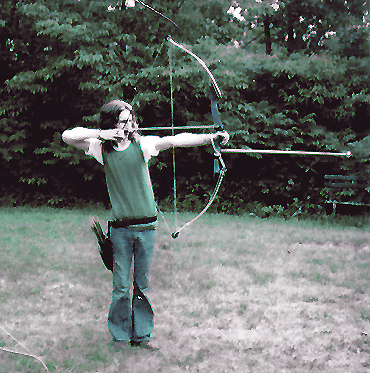
Here I'm String Walking the new Black Widow TD.
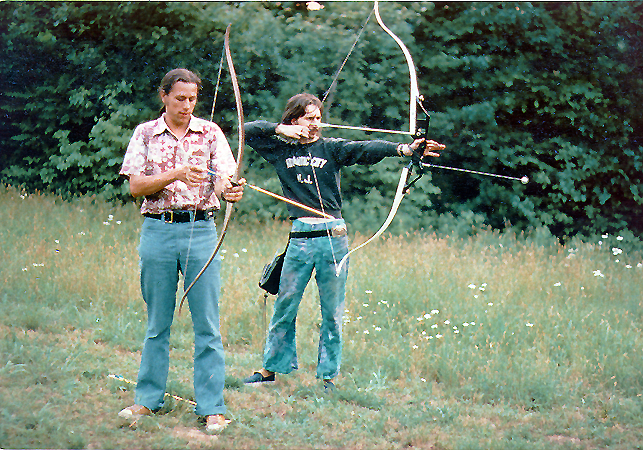
It was my good fortune to meet Wayne Woerdich, who turned me on to the wonderful world of string walking. That's me on the right with long time friend Richie Ayres, guitar player from the band Elephant's Memory.Yes, that's the band with the first body painted nudes on the front of their album, that got past the censors, and later became John Lennon's band after he had left the Beatles.
There is no more challenging sport in this world than the sport of archery. In the world of archery, there are two popular types: The first is called Target Archery, and this is the FITA round that is shot in the Olympic Games. The men shoot distances up to 90 meters on a flat open field. The targets are the popular multi-colored target most people recognize as an archery target.
The second, often considered much harder than the FITA round, is called Field Archery.
In Field Archery, the shooting distances go from ten yards to eighty yards, with the size of the bull's-eye ranging from the size of a quarter at ten yards to the size of a baseball at eighty yards. There is no harder type of archery to shoot than Field Archery. In addition, Field archery is not a high profile sport as it is shot in the woods, hidden from public view, with the course laid out very much like a golf course. The shooters walk along paths from target to target in the woods.The archer may be required to shoot uphill or down hill. At some Shooting ranges, the designers skillfully go out of their way to make things very hard using the lay of the land to create difficult shooting challenges. I have shot across sand in blinding sunlight in 107 degrees heat trying to aim through the mirages created by the sun.
In some of the mountain area ranges, besides shooting along the side of a mountain with the ground slanted under your feet, you may also be challenged by a target that is eighty yards away, and have to shoot almost straight down off a cliff.
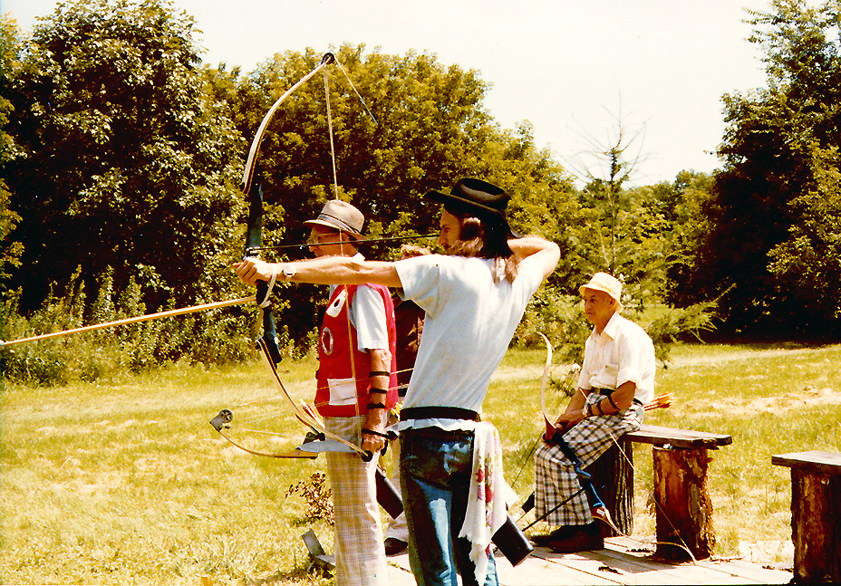
Consider now the fact that I shot Field Archery without any sights on my bow. It is not that sights are not allowed; in the Free-Style Unlimited divisions, they use scopes with peep sights and string release aids that fire the shot with something that is much like the trigger on a firearm. Shooting in the Bare-Bow division is a challenge. Not to mention when you beat a Free-Styler's score, you go home feeling like you really had a good day!!!!
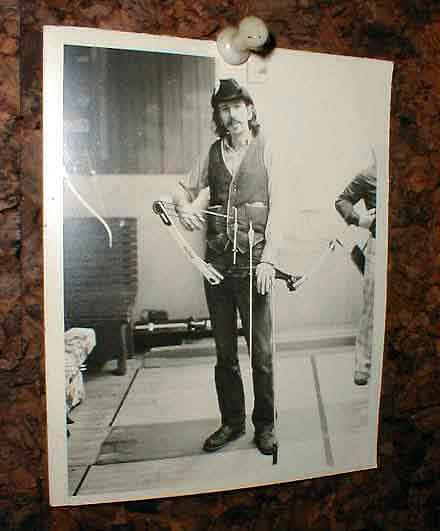
Yes, that's me back around 1975 or so. That's a Jennings' compound bow. I had just started shooting it after an experimental two wheel Ramco blew up on me after the Nationals. That Ramco spit out arrows like they were shot from a cannon. It had more stored energy with it's pre stressed recurved limbs than any bow made at that time. There were only three of these experimental two wheel Ramco bows made. When that bow let go, it virtually exploded!
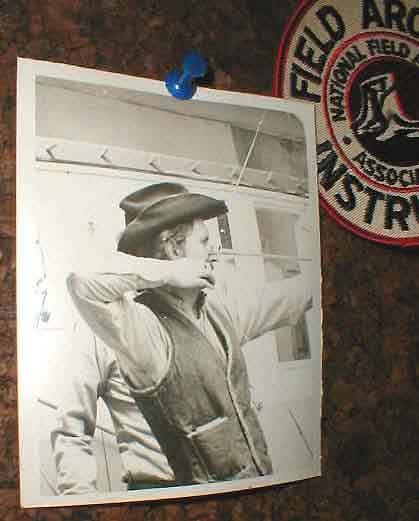
If you will notice in the picture above, my right hand is not touching the arrow in any way. The arrow just clips onto the bow string in between two nock sets to prevent it from sliding down the string. The distance from the arrow that my hand is placed governs the elevation of the arrow flight. I look down the arrow and sight it at the target much like looking down the barrel of a shot gun. This technique of shooting is called "String Walking." It is the most accurate method there is when shooting without sights on the bow. Also, note my two finger hold on the string.
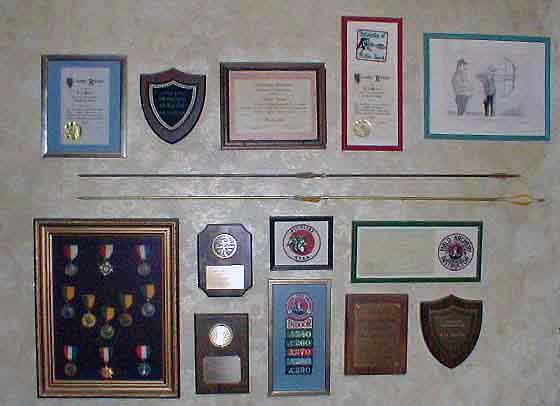
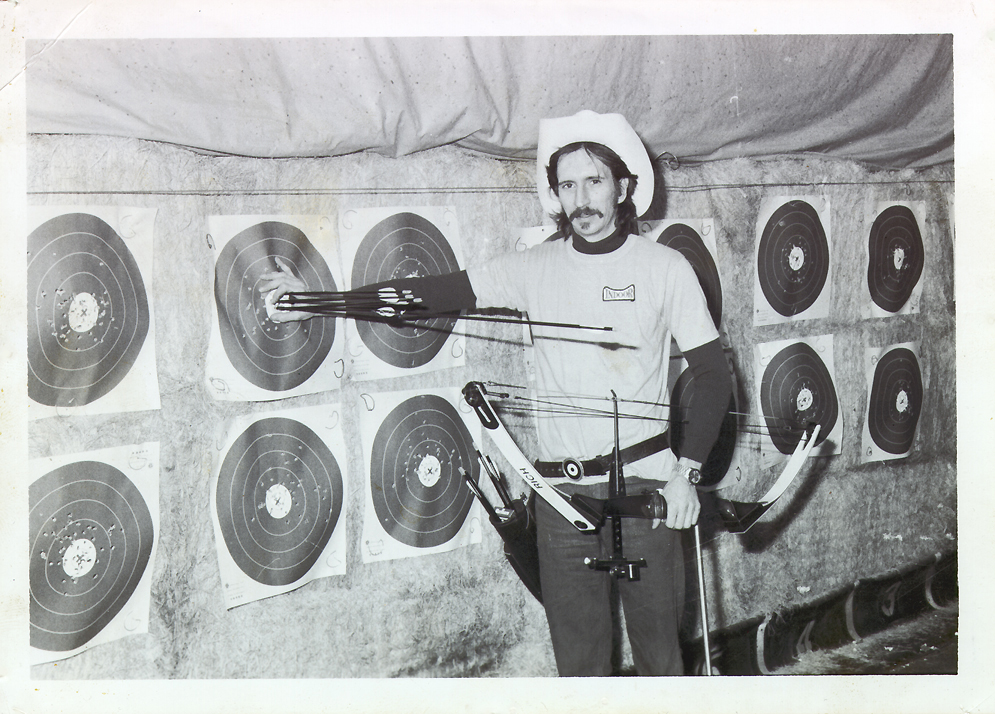
Those two long things near the middle of this collection of dust collectors are two arrows that I had shot into the back of each other. In the course of my shooting life, I had this happen twelve more times since these first two memorable experiences.
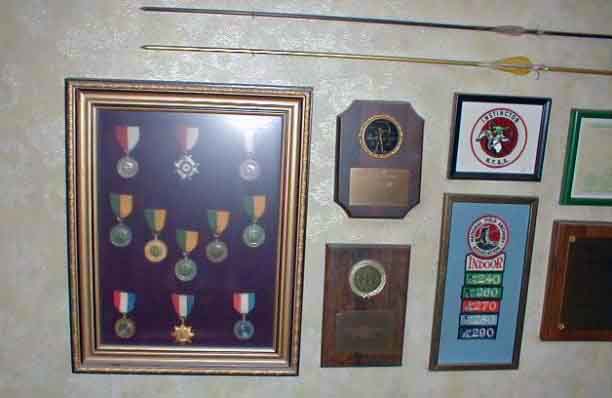
After a few years of competitive shooting you start to notice a growing collection of dust collectors. Some of them have had great meaning as they remind me of how hard it was to meet the challenge. Those I have kept because of their special personal importance. Most of the others found there way to the attic in boxes later to be donated to archery clubs to hand out as awards for the new shooters to put in their place of personal importance.
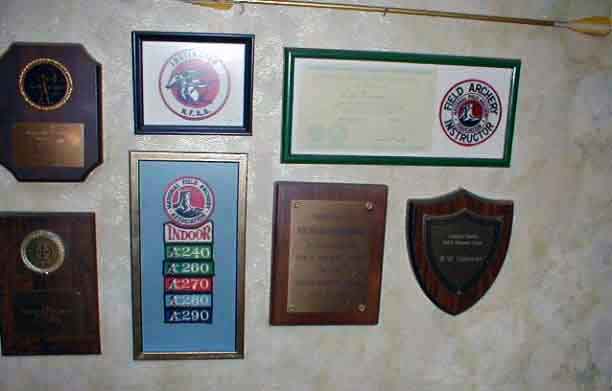
One of the indoor games that I had shot most often on many Sunday morning competitions and weekly Indoor Leagues was the NFAA Indoor Round. A perfect game totals 300 points. I had managed to carry a 290 average shooting Bare-Bow.
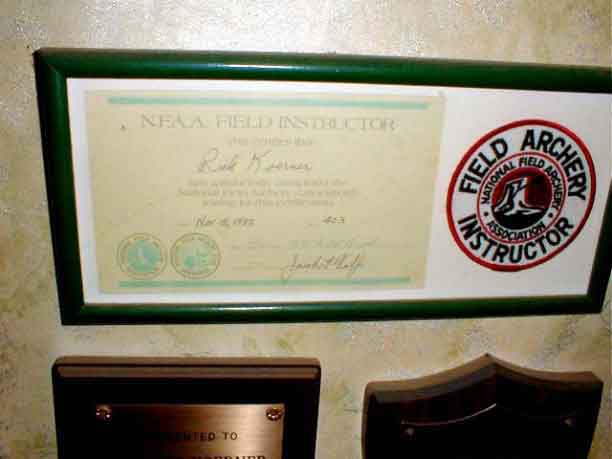
It just is a matter of time when you channel many years of competitive archery into your life that you wind up doing a lot of teaching along the way. The look of excitement in the eyes of your student the first time they win a major championship is so rewarding. There is nothing more satisfying like it in the world.Competition shooting is quite different than what is required in bow hunting. Here, it's only the first shot that counts. Everything rides on it. There is a completely different approach required to teach the proper shooting skills and metal attitude necessary for the bow hunter to be successful.
These two forms of archery are worlds apart from each other, and the bow and the arrow are the only thing they have in common. The coaching methods for helping bow hunters is completely different from that used teaching competition target shooting.
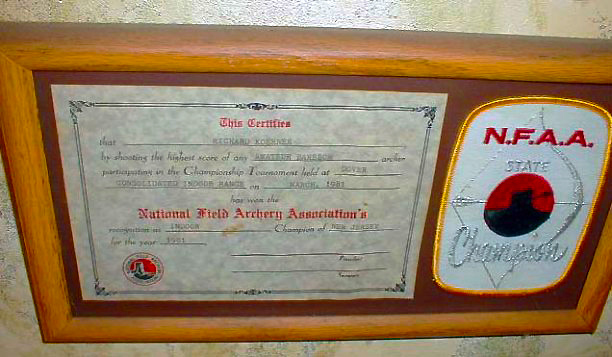
My first sanctioned indoor shooting championship win. I never worked so hard in my life!
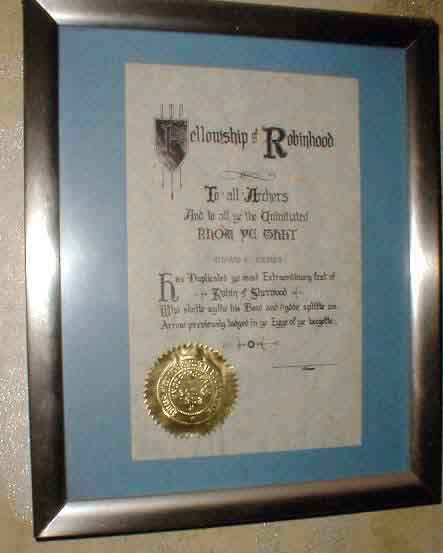
My induction into the Fellowship of Robinhood for my first Robinhood in sanctioned competition. It was for many years just a dream. Then it happened when least expected.
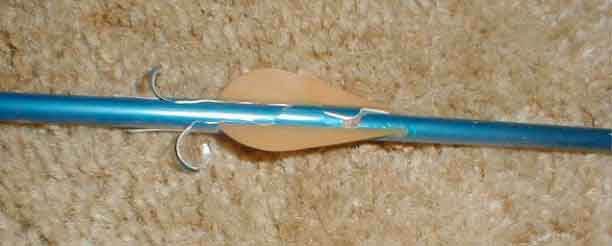
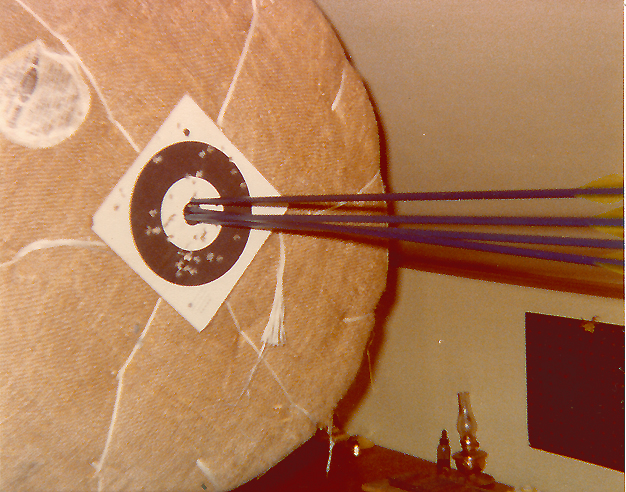
This is what a Robinhood looks like with the modern arrows that are made from aluminum tubing.
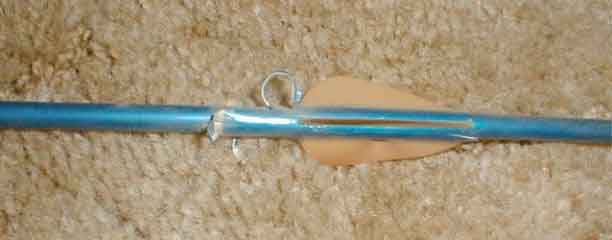
Notice the very small plastic vanes that are used in place of feathers that are used for long distance outdoor shooting.
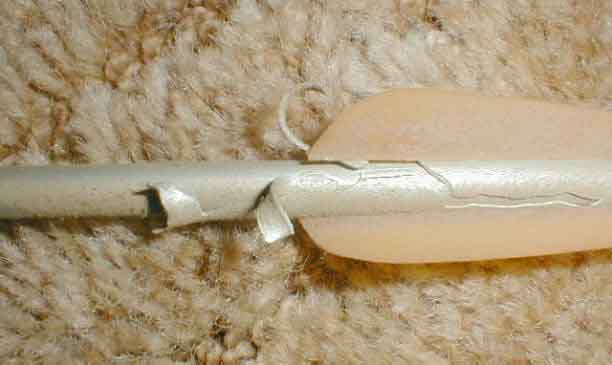
This Robinhood happened on a sixty yard target while shooting an outdoor Field Round.
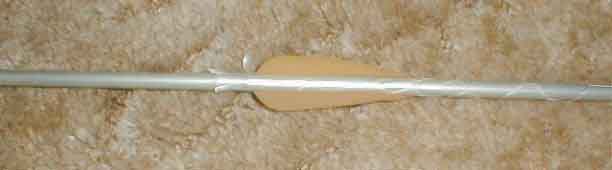
Both ends of the shafts have tapered points. On the front of the shaft is the weighted target point that is used to pierce the paper target. On the back of the arrow shaft is the drawn tapered point that the plastic nock is glued on to that attaches the arrow to the bowstring.
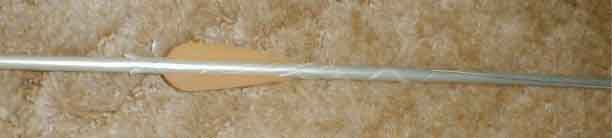
The reason that a Robinhood doesn't happen very often is because of these points on both ends. To be able to send one arrow shaft down the center of another, those two points have to hit exactly dead center to each other.Glance outs, broken nocks, and damaged arrows become more common place when your shooting skills hit the higher levels.
Lost points due to glance outs just goes with the territory, and is the price you have to pay when
you arrive at the top of your game. BTW, shooting nocks is a great money game, and makes you a better shooter too.
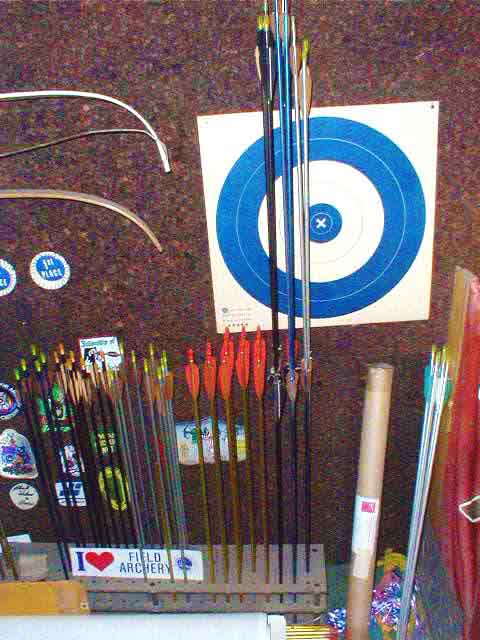
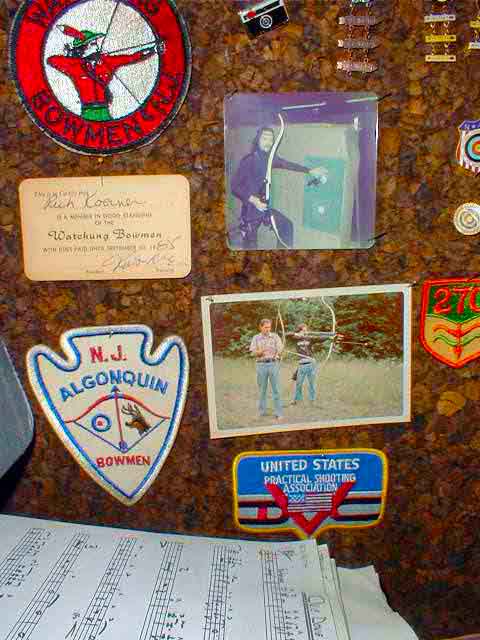
Here are some of the different arrows I had used and 12 more Robinhoods I had shot along the way. Also there are some of the archery club patches that I had gotten by patch trading at some of the different competitions I had attended.For anyone interested in the sport of archery, just drop me an e-mail or a phone call.
Next to music, archery is my second love.
======================================================================================================
(Update February 2011)Since I had put this page on my website, I have had a lot of emails and phone calls with many comments on this page. There were questions on field archery, string walking techniques, and a lot on selecting the best compound bow for string walking.
The world of archery has changed so fast since I left the sport, it makes my head spin. I really don't know how best to approach these subjects.
I guess the best way is through a little review of days past.
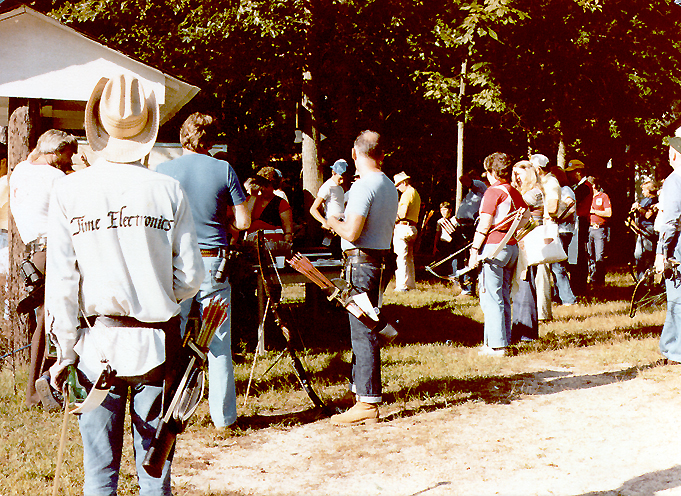
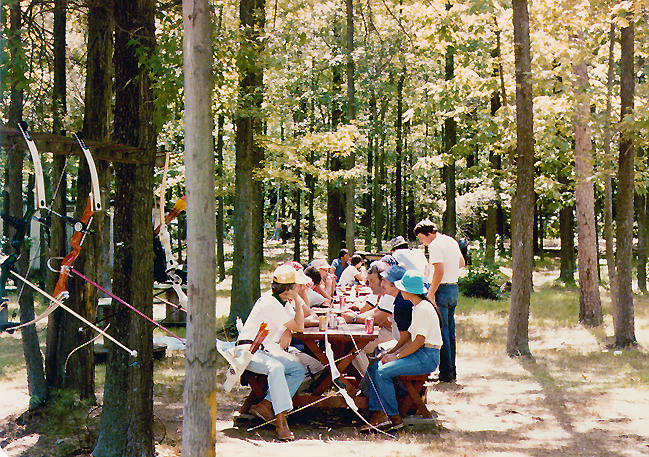
Yes, that's me on a Sunday morning getting ready to register for a day in the woods shooting a double NFAA field round. Now, its off to grab an outdoor cooked breakfast and coffee. While my breakfast was cooking on the grill, I found a spot on one of the many picnic tables to have a social breakfast with some of the shooters who came to enjoy a day in the woods.
To shoot 56 targets for a double field round, you can't spend too much time socializing. So, off to the practice bails to warm up and find a shooting group to go out on the shooting course.
In the NFAA field round, a shooting group is no less than 3 shooters, and no more than 4 shooters.
LOL, as usual... I'll go out on the course with anyone who are there to just enjoy a day in the woods having fun. Now, don't get me wrong. With me, shooting is one very serious PERSONAL thing when my feet are on the shoot stake. When my feet are not at the shooting stake, its a very SOCIAL thing, and I'm there to enjoy just being with people.
In the NFAA field round the archers shoot in pairs, one at a time for 4 arrows. Then, the other pair shoots their 4 arrows. After 14 targets, the shooting order is reversed for the second half of the 28 target field round.
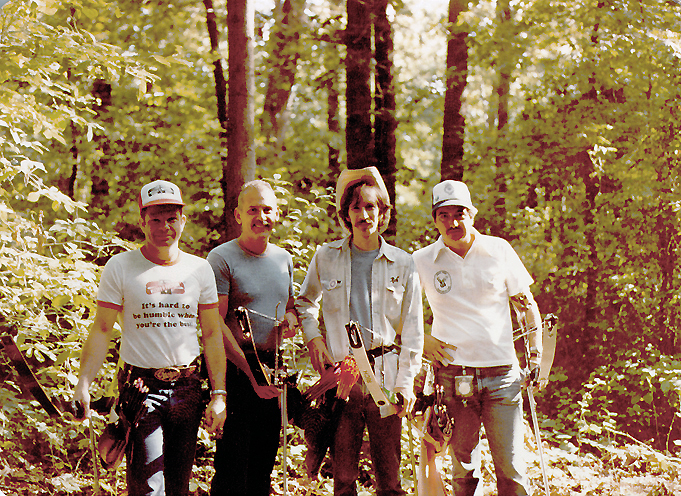
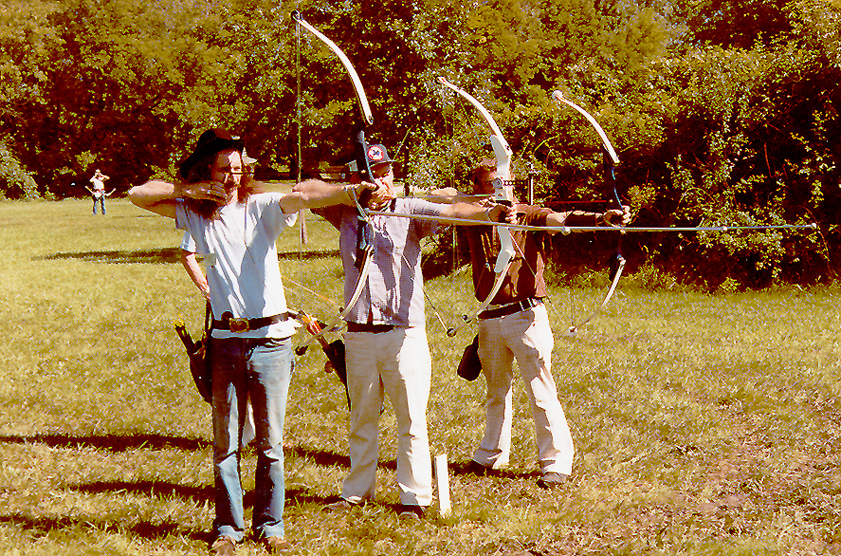
Note - that in the above picture of our shooting group I'm the only bare bow shooter. Of the others, one is a lefty, and all three are shooting in the Freestyle class of shooters. I'm not directly competing against them for the Freestyle class award. I'm shooting for high score against all the other registered barebow shooters on the course that day. You need to know this, because of what happened later in the day.
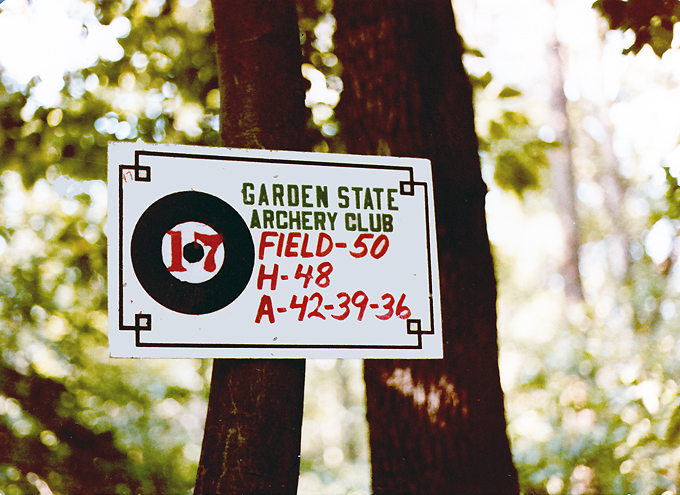
Little did I know that when we had reached the 17th 50 yd. target
that things were going to change suddenly.
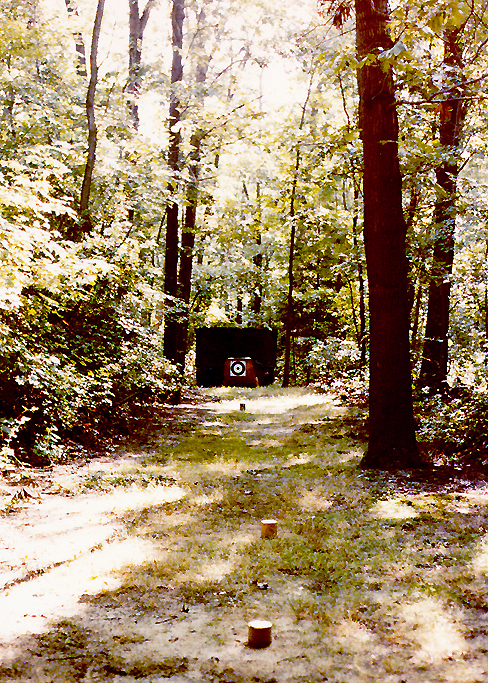
This is how the 17th 50 yrd. target looks from the shooting stake. At this point on the score cards I'm in the lead on points and 2nd in the shooting order. The fellow from the far right in the group picture shoots before me.The two of us take our positions at the shooting stake, and I wait for him to take his 1st shot. So, now he starts laying the "psych" on me. Like he's going to talk me out of points so he can take the lead in our group. Damn, where is this coming from? It was a fun day up till now.
As he's getting ready to take his shot, he starts telling me this and that.... then shoots one in the spot. My girlfriend, who had been spotting arrows for everyone in the group, calls his blue arrow as a "3:00 possible X".
Now, I have to make a decision. Do I play him, or ignore his sudden "psych" game?
So, I glance over at my girl friend, and she gives me a wink.
OK. I start my string walking setup routine.
Taking my time, now at a much slower than normal rate, I snap the arrow on the string and lay it on the my modified "springy" rest, slip the tab under the knock set, count down the stitches and thumb nail click two wraps on the serving, slip the tab to my thumb nail, set my fingers on the tab, and draw up into a very intentional and very much longer HOLD.
You see, I knew that... after all this drawn out slow motion setup time, that once I finally reached full draw, ALL eyes would be on the target. Not me.
With this in place, I very quietly *put down* the shot, and watched them looking at the target. After a short while, I told my girl friend to put down the spotting glasses.
So there I am looking at the ground for a while. I took a long deep breath.
Then, I look up at this shooter with the psych and I tell him, "You know... I find the way the sunlight is hitting the knock on your arrow to be very distracting."
So, I start my very slow motion setup routine again up to full draw. Then, same as before, I slowly put down and tell the girl friend to put down the glasses again.
Now, I look back up at him and I tell him, "You know with that knock of yours being so bright, it's just asking to get blasted, and it's very hard to aim away from it".
Yes, you guessed right. I started my very slow motion routine over again, with long hold, and not shooting the shot.
Looking at him again I said, "You know, I really hope you brought enough knocks and spare arrows with you today to make it to the end of the 28 targets.
And... I start the whole this routine all over again, with the long hold before putting down the shot.
Now, I tell him... "You really have to STOP doing that, I don't want you to be mad at me"!
He then asks, "Stop doing what, and why would I be mad at you"?
Looking him straight in the eye, I told him, "You really have to stop putting your arrows in front of my arrows like that!!!!!!! You do know... YOU are forcing me bust up your arrows"!
You should have seen the look on his face. It was priceless.
Without saying a word more, I start now, an even SLOWER setup routine.
I hit full draw and focused very hard on his knock, and *waited* for the shot to go off.
When everyone heard this very loud CRACK!!!! I got 2 Holy Shits, and 1 Oh My God!!!!!!!!!!!!!!!!!!!!!!!!!!
With this, they all start walking down to the target. I hang my bow up on the tree bow rack and start heading down to the target.
The next thing I know, the girl friend has the camera out and shoots a picture. <smile>
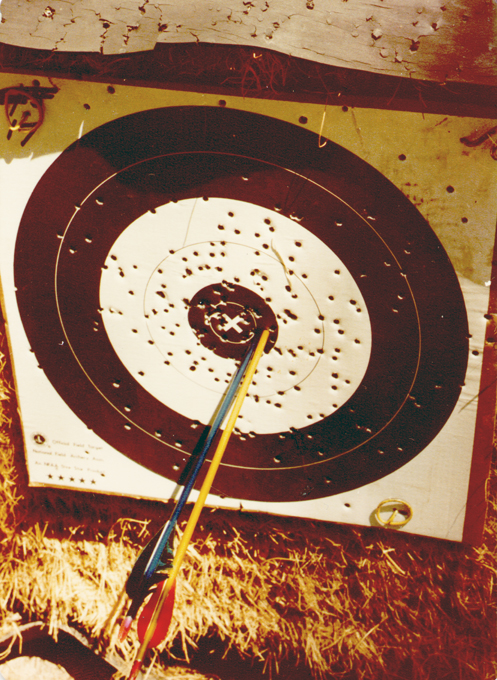
=======================================================================================================A SPECIAL "Barebow Shooters" NOTE - it's always nice to have a girlfriend with a camera when you *REALLY* manage to pull off... the outrageous.
A SPECIAL "Reader's" NOTE - This is also an "example" of a game I created for coaching Bow Hunters, which I called "One Shot". Later, when I get the time, I will write on the major coaching differences between that of the Bow Hunting and the Competitive Archer.
To think the coaching methods would be the same is the biggest mistake an archery coach can make. The whole mentality and approach behind the "shot" for both,
are in reality... a universe apart from each other.For the Bow Hunter, only the first shot counts. For the Competitive Shooter, all
shots count. To think simply repeating the former satisfies the latter ignores
the variables of the one, and the constants of the other. There, is your error.To master intense games of "One Shot", can benefit both archers as needed.
What happens when a good bare bow shooter goes to a scope and a hook?
I was challenged to be a substitute shooter for an indoor league team of hook shooters.
This happened on my 2nd or 3rd night out while still tweaking the the bow's setup. During the season, I was told, I'd never go back to shooting barebow. Some of the hook shooters on the league even said, I'd never make it as a hook shooter too.To tell the truth, I was bored to death before the indoor season had ended. It didn't take me long to find out this ain't for me and that I was born to be a string walking barebow shooter.
Many times our bow club, the Watchung Bowmen, hosted the NFAA indoor round competitions. And, many times I had witnessed a few of New Jersey's best hook shooters quit, pack up, and go home after driving miles to get to our NFAA event.
They left because of an X ring Count.???? They dropped 4 or 5 X's!!!!!!!
And now... they are going home to do what?????
This is crazy, over the top, and Off the Hook!!!!!!!!!!!!!!!
<wink>
This is not my idea of what archery should be all about.
OK. I'm going to let you all in how I setup the house so I could practice everyday. I picked up a target mat and hung it from the ceiling at one end of the house on the second floor. Then, from the top of the stairs at the other end of the house, I shot through a doorway to the target mat.
Shooting distance - just inches under 20 yards.
This way I could practice any time I wanted to. And, outside of the family only three people knew I was doing this.
I started shooting at the NFAA indoor target. I soon found the target was too big for a barebow shooter to tighten up their groups. Too much floating room.
Next, I went to the NFAA outdoor target for 15-30 yard target. After about a month, I needed a still smaller target. Next was the smallest NFAA outdoor Frog target.
That was the ticket. If our club had a busy outdoor season I had a lot for targets to take home for my practice sessions.
How small of a dot can you see and HIT, in *your* sight picture???
==========================================================================================================
Coming Soon - On matters of Wayne Woerdich, string walking, and my
first
compound bow. That experimental Ramco 2 Wheeler.
=======================================================================================================
Rich's Barebow Family Scrapbook
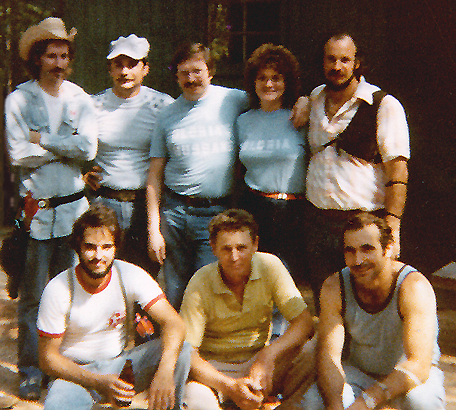
September 26,1980 New Jersey vs Connecticut Bare Bow Challenge Match
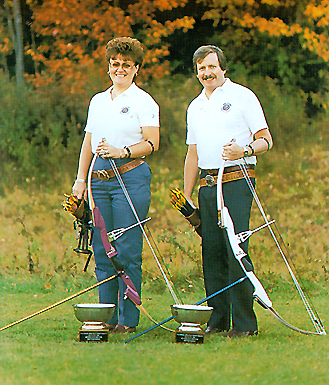
Bruce and Gloria Shelley
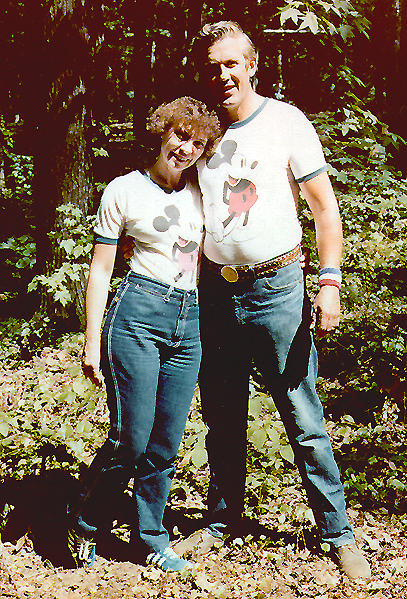
Kathy and Ed Jarvie
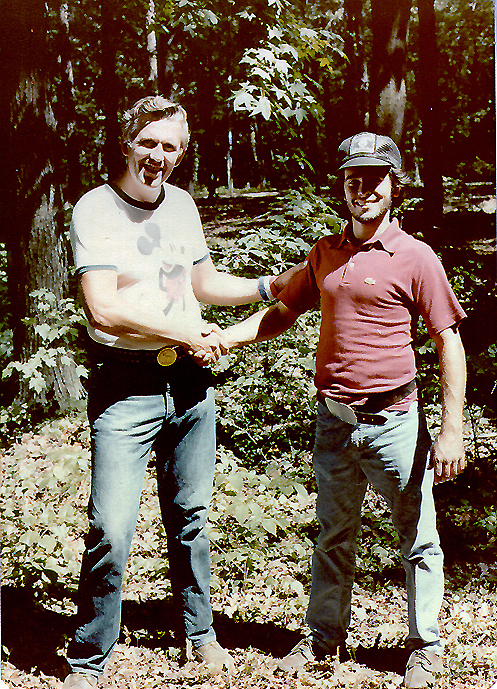
Ed Jarvie and Frank Burdi
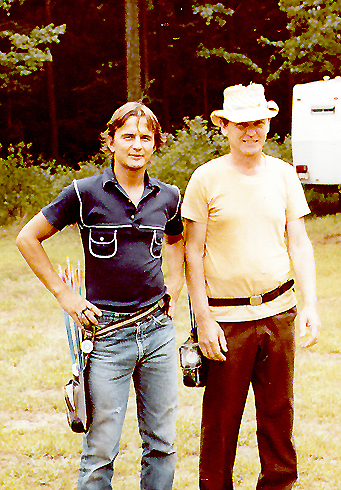
Mike and Lester Bennett
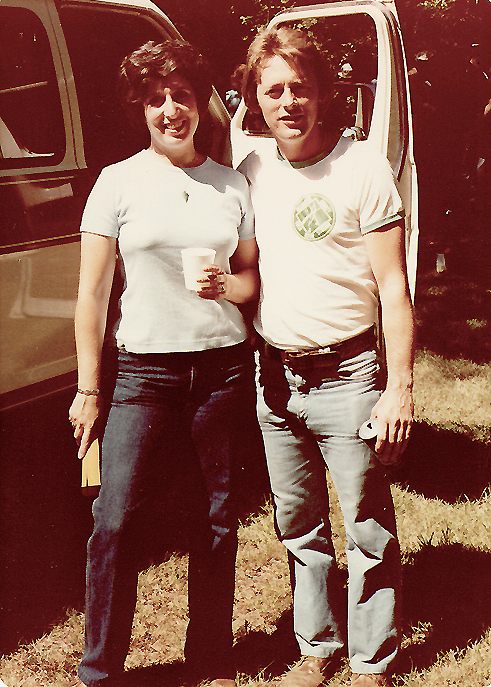
Judy and Ed Albright
=======================================================================================================

©Copyright R.K.Koerner 2001 All Rights
Reserved.
|